Wait, what? How?Up has exactly the same plot as The Incredibles, too
Dinsey's Wreck-It Ralph: A love-letter to videogames
-
Green Gibbon!

- BUTT CHEESE
- Posts: 4648
- Joined: Fri May 21, 2004 11:39 am
- Location: A far eastern land across the sea
- Contact:
Re: Dinsey's Wreck-It Ralph: A love-letter to videogames
To give more examples using the Hitman trailer, a gun control activist might single out the gun violence as a bad message or a Catholic might choose to take offense at the portrayal of nuns. It all misses the point.
-
Jack Bz
- Posts: 43
- Joined: Thu Aug 03, 2006 3:19 pm
- Location: London
- Contact:
Re: Dinsey's Wreck-It Ralph: A love-letter to videogames
I would just like to say that this has been a very interesting discussion to read, and I very much agree with Popcorn/Delphine etc and also identify myself as a feminist.
Does anyone think Lilo and Stitch was brilliant, or at least really refreshing? The (human) protagonist isn't white, is female, isn't thin, nor does the film have any kind of princess complex. And the whole plot is about unconventional families and outcasts. I've always thought it was hugely underrated.
Does anyone think Lilo and Stitch was brilliant, or at least really refreshing? The (human) protagonist isn't white, is female, isn't thin, nor does the film have any kind of princess complex. And the whole plot is about unconventional families and outcasts. I've always thought it was hugely underrated.
-
G.Silver

- Drano Master
- Posts: 2750
- Joined: Sat May 22, 2004 12:58 am
- Location: warshington
- Contact:
Re: Dinsey's Wreck-It Ralph: A love-letter to videogames
I had the same response but suspected I might be taking some kind of bait.Green Gibbon! wrote:Wait, what? How?Up has exactly the same plot as The Incredibles, too
-
Esrever

- Drano Master
- Posts: 2981
- Joined: Mon May 24, 2004 2:26 am
- Contact:
Re: Dinsey's Wreck-It Ralph: A love-letter to videogames
I like Lilo and Stitch a lot. It's different, and some of those differences are problematic, but I'll always take flawed-but-interesting over solid-but-bland.
I'm sad we'll never see the Chris Sanders version of American Dog/Bolt. I know it had pretty serious story problems. But if they'd let him finish it like he wanted, at least we would have had a movie that was distinct and unique, even if it did have issues. Instead we have Bolt, a safe, boring by-the-numbers Disney film that absolutely no one remembers or cares about.
I'm sad we'll never see the Chris Sanders version of American Dog/Bolt. I know it had pretty serious story problems. But if they'd let him finish it like he wanted, at least we would have had a movie that was distinct and unique, even if it did have issues. Instead we have Bolt, a safe, boring by-the-numbers Disney film that absolutely no one remembers or cares about.
-
Radrappy

- Posts: 1329
- Joined: Wed May 26, 2004 10:53 pm
- Contact:
Re: Dinsey's Wreck-It Ralph: A love-letter to videogames
Oh come on dude, Lilo and Stitch is a great film but not for any of these reasons. The race of the protagonist should never be the reason you liked something.Jack Bz wrote:I The (human) protagonist isn't white, is female, isn't thin, nor does the film have any kind of princess complex.
-
Esrever
- Drano Master
- Posts: 2981
- Joined: Mon May 24, 2004 2:26 am
- Contact:
Re: Dinsey's Wreck-It Ralph: A love-letter to videogames
I always thought it was telling that Lasseter didn't like Lilo and Stitch. Supposedly he thought that it was too quirky, and that Lilo and Stitch were both too unlikeable. Both characters' propensity for jerkish or selfish behaviour is certainly toned down quite a bit in subsequent L&S stuff. (I wonder if any of it stems from his experiences realizing Toy Story's early story problems, where Woody was way too much of a dick to root for.)
It bothers me that Lasseter is now such a singular influence on the direction of every animated film Disney makes... especially the non-Pixar ones. He's a talented dude, but he has bad impulses that need to be tempered by the rest of the braintrust. You read interviews with directors where they talk about the changes Lasseter encourages, and it's always more schmaltz, more heartstring pulling, more maudlin sentiment.
It bothers me that Lasseter is now such a singular influence on the direction of every animated film Disney makes... especially the non-Pixar ones. He's a talented dude, but he has bad impulses that need to be tempered by the rest of the braintrust. You read interviews with directors where they talk about the changes Lasseter encourages, and it's always more schmaltz, more heartstring pulling, more maudlin sentiment.
-
Delphine

- Horrid, Pmpous Wench
- Posts: 4720
- Joined: Fri May 21, 2004 1:05 pm
- Location: Los Angeles, CA
- Contact:
Re: Dinsey's Wreck-It Ralph: A love-letter to videogames
True, but the movie put absolutely no effort into highlighting that. The big message was "stick with your family no matter what" -- a good thing, of course (usually!). It's the "if everyone's special then nobody is" bit that gets to me. Everyone has potential. Realizing this does not make an individual person not worthy, but the film rejects that -- only superheroes are worthy in the end. So worthy that:G.Silver wrote:His failing, like you say, was his own inability to recognize that he was already great, the best revenge is to live well, etc.
Yeah, that was... off. There was no one using Syndrome as an example of why supers should never come back? No one doing any in-depth research to find out who the Incredibles were and trying to expose them? I know they needed a Disney ending, but come now.G.Silver wrote:The creepy part is that at the end of the film everything goes back to normal and no one appears to have learned anything, except that supers get to go out in the open again and all the problems with litigation at the start of the film are resolved for no reason other than that, gosh, those super heroes sure are great, aren't they?
Gun activists and Catholics aren't systematically oppressed by society. It is not the same thing. It is a very rare circumstance where either group would feel unsafe in a room full of their opposite. There is a list of rules that minorities need to follow -- mostly unwritten unless you regularly peruse tumblr -- in order to be safe in a room full of the majority. And even then it is not true safety. That you equate enthusiastic firearm hostility with being black, or gay, or Muslim, or female, is asinine. It is not about being offended. It is about being othered.Green Gibbon! wrote:To give more examples using the Hitman trailer, a gun control activist might single out the gun violence as a bad message or a Catholic might choose to take offense at the portrayal of nuns.
-
Green Gibbon!
- BUTT CHEESE
- Posts: 4648
- Joined: Fri May 21, 2004 11:39 am
- Location: A far eastern land across the sea
- Contact:
Re: Dinsey's Wreck-It Ralph: A love-letter to videogames
Um... women aren't a minority?
And by referring to the "majority" as something to be feared - to be kept safe from while you stick to your own kind - aren't you "otherizing" yourself? Now who's discriminating?
And by referring to the "majority" as something to be feared - to be kept safe from while you stick to your own kind - aren't you "otherizing" yourself? Now who's discriminating?
That's kind of interesting. I didn't know he had that kind of pull on individual movies. Where are these interviews?You read interviews with directors where they talk about the changes Lasseter encourages, and it's always more schmaltz, more heartstring pulling, more maudlin sentiment.
-
Delphine
- Horrid, Pmpous Wench
- Posts: 4720
- Joined: Fri May 21, 2004 1:05 pm
- Location: Los Angeles, CA
- Contact:
Re: Dinsey's Wreck-It Ralph: A love-letter to videogames
I'm sorry, am I supposed to take that seriously?Green Gibbon! wrote:And by referring to the "majority" as something to be feared - to be kept safe from while you stick to your own kind - aren't you "otherizing" yourself? Now who's discriminating?
-
Green Gibbon!
- BUTT CHEESE
- Posts: 4648
- Joined: Fri May 21, 2004 11:39 am
- Location: A far eastern land across the sea
- Contact:
Re: Dinsey's Wreck-It Ralph: A love-letter to videogames
I'll take that as a concession.
I don't know about the former. Have you ever been to south Louisiana? I don't recommend it.Gun activists and Catholics aren't systematically oppressed by society.
-
Esrever
- Drano Master
- Posts: 2981
- Joined: Mon May 24, 2004 2:26 am
- Contact:
Re: Dinsey's Wreck-It Ralph: A love-letter to videogames
Women aren't a minority, which is why it is extra screwy that they are so under-represented as protagonists. If you are charitable you can say it's on unconscious omission or if you're cynical you can assume it's a systematic policy. But you have to acknowledge it's indicative of SOMETHING; that the way films are now is not some sort of untainted apolitical base reality. Because if it was, half our films would have female leads.
When Disney bought Pixar in 2006, Lasseter was appointed CCO of both Pixar and Walt Disney Animation Studios. (The only person with more authority than him is Iger, Disney's CEO.) That gave him a lot of authority over the stuff in production at the time. Sometimes I think that influence is positive and sometimes it's negative. The main thing is that it's always very consistent with his personal tastes, which has a kind of homogenizing effect, and hurts some films as much as it helps others. John likes sincerity and emotion, and does not like cynicism or sarcasm or meanness. Unfortunately there is a time and place for all those things, and I feel like he needs to have his sap tempered a little by other voices.
I remember reading an interview with the director of Meet the Robinsons (I wish I could find it) where he described the day he screened the in-progress version for Lasseter as being the "hardest day of his life", or something similar. They wound up redoing about 60% of the film, and gave the bowler hat villain an emotional family-based backstory instead of keeping him a goofy mustache twirling archtype. (Despite the fact that his original form was the most popular element of the film in test screenings.) The final film has a very strong emphasis on wanting to belong and be part of a family that was not really so prominent in the more anarchic early version.
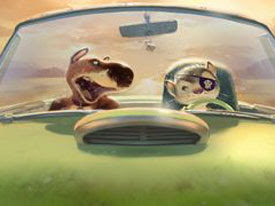
Bolt was the next film in production at WDAS, and was still in the story stage. Originally, "American Dog" was about a famous TV star dog who is stranded in the desert and teams up with a pirate cat and an radioactive rabbit looking for new homes to get back, all the while thinking it was being filmed for TV. Lasseter thought it was too quirky and didn't have enough heart or focus (quite possibly true, we'll never know), and Sanders refused to make the changes asked of him, so he left Disney. The final version of Bolt is about a superhero TV dog who thinks the show is real and that he really has super powers. (IE: the same plot as Buzz Lightyear.)
The Princess and the Frog is the first film to be produced entirely during Lasseter's tenure as studio head. I don't know much about it other than seeing it and not liking it. There is a character death near the end that is so stupid and so arbitrarily, inappropriately maudlin... blech.
I remember reading an anonymous WDAS animator's comment that the only reason they managed to finally finish Tangled and stop battling about the emotional tone of the film is because "the eye of sauron" had to turn away to go take over directing the troubled Cars 2. Tangled was a movie that was constantly in flux in terms of how straight/how irreverent to play the adaptation. I assume Lasseter is responsible for steering the film back towards a more classic take, and I'm pretty sure I read that he pushed to emphasize the more real-world styled motherly relationship between Rapunzel and Mother Gothel. (Not necessarily bad decisions.)
Lasseter also basically single-handily cancelled Disney's direct-to-video sequel business, conceeding only to franchise-driven dtv productions for stuff like Disney Fairies and Disney Princesses.
When Disney bought Pixar in 2006, Lasseter was appointed CCO of both Pixar and Walt Disney Animation Studios. (The only person with more authority than him is Iger, Disney's CEO.) That gave him a lot of authority over the stuff in production at the time. Sometimes I think that influence is positive and sometimes it's negative. The main thing is that it's always very consistent with his personal tastes, which has a kind of homogenizing effect, and hurts some films as much as it helps others. John likes sincerity and emotion, and does not like cynicism or sarcasm or meanness. Unfortunately there is a time and place for all those things, and I feel like he needs to have his sap tempered a little by other voices.
I remember reading an interview with the director of Meet the Robinsons (I wish I could find it) where he described the day he screened the in-progress version for Lasseter as being the "hardest day of his life", or something similar. They wound up redoing about 60% of the film, and gave the bowler hat villain an emotional family-based backstory instead of keeping him a goofy mustache twirling archtype. (Despite the fact that his original form was the most popular element of the film in test screenings.) The final film has a very strong emphasis on wanting to belong and be part of a family that was not really so prominent in the more anarchic early version.
Bolt was the next film in production at WDAS, and was still in the story stage. Originally, "American Dog" was about a famous TV star dog who is stranded in the desert and teams up with a pirate cat and an radioactive rabbit looking for new homes to get back, all the while thinking it was being filmed for TV. Lasseter thought it was too quirky and didn't have enough heart or focus (quite possibly true, we'll never know), and Sanders refused to make the changes asked of him, so he left Disney. The final version of Bolt is about a superhero TV dog who thinks the show is real and that he really has super powers. (IE: the same plot as Buzz Lightyear.)
The Princess and the Frog is the first film to be produced entirely during Lasseter's tenure as studio head. I don't know much about it other than seeing it and not liking it. There is a character death near the end that is so stupid and so arbitrarily, inappropriately maudlin... blech.
I remember reading an anonymous WDAS animator's comment that the only reason they managed to finally finish Tangled and stop battling about the emotional tone of the film is because "the eye of sauron" had to turn away to go take over directing the troubled Cars 2. Tangled was a movie that was constantly in flux in terms of how straight/how irreverent to play the adaptation. I assume Lasseter is responsible for steering the film back towards a more classic take, and I'm pretty sure I read that he pushed to emphasize the more real-world styled motherly relationship between Rapunzel and Mother Gothel. (Not necessarily bad decisions.)
Lasseter also basically single-handily cancelled Disney's direct-to-video sequel business, conceeding only to franchise-driven dtv productions for stuff like Disney Fairies and Disney Princesses.
-
Delphine
- Horrid, Pmpous Wench
- Posts: 4720
- Joined: Fri May 21, 2004 1:05 pm
- Location: Los Angeles, CA
- Contact:
Re: Dinsey's Wreck-It Ralph: A love-letter to videogames
You can take that as running out of patience with an ignorant straight man. But please, feel free to tell me more about my experience as a gay women as you clearly know more than I do.Green Gibbon! wrote:I'll take that as a concession.
Numberwise no, but take an excerpt of the definition from wikipedia and things change: the term refers to a category that is differentiated and defined by the social majority, that is, those who hold the majority of positions of social power in a society. I was under the impression we were discussing societal power, not playing a numbers game. If we were doing that it would be clear that globally white people are in the minority, but I think we all know it doesn't exactly work that way.Esrever wrote:Women aren't a minority
-
Green Gibbon!
- BUTT CHEESE
- Posts: 4648
- Joined: Fri May 21, 2004 11:39 am
- Location: A far eastern land across the sea
- Contact:
Re: Dinsey's Wreck-It Ralph: A love-letter to videogames
Boo-hoo. Do you want me to pat you on the head and give you some warm milk?
Sorry, but I'm too busy eating caviar and controlling little people from my blackberry sitting on my big white man easy chair.
Sorry, but I'm too busy eating caviar and controlling little people from my blackberry sitting on my big white man easy chair.
-
Esrever
- Drano Master
- Posts: 2981
- Joined: Mon May 24, 2004 2:26 am
- Contact:
Re: Dinsey's Wreck-It Ralph: A love-letter to videogames
I was definitely speaking strictly in terms of numbers, but only because I feel like those numbers make the lack of female protagonists seem even stupider. We are literally talking about half the population of North America. There is no way anyone can argue that their under-representation in our films is anything other than intentional, and not just some weird coincidence in the pursuit of an apolitical, agendaless "good story".
GG, I don't know how to tell you this, but the relative shittiness of your life is not really a standard you can use to gauge societal privileged. You are a white, straight dude. Statistically, that means you are more likely to make a higher income, less likely to get raped, and very likely to watch a lot of movies about other straight white males. Those are realities, there is no arguing with them. But they don't mean you get to join the illuminati. (Sorry.) There are plenty of ways to be fucked over. There are just more ways for some people than others.
GG, I don't know how to tell you this, but the relative shittiness of your life is not really a standard you can use to gauge societal privileged. You are a white, straight dude. Statistically, that means you are more likely to make a higher income, less likely to get raped, and very likely to watch a lot of movies about other straight white males. Those are realities, there is no arguing with them. But they don't mean you get to join the illuminati. (Sorry.) There are plenty of ways to be fucked over. There are just more ways for some people than others.
-
Radrappy
- Posts: 1329
- Joined: Wed May 26, 2004 10:53 pm
- Contact:
Re: Dinsey's Wreck-It Ralph: A love-letter to videogames
Esrever wrote:Women aren't a minority, which is why it is extra screwy that they are so under-represented as protagonists. If you are charitable you can say it's on unconscious omission or if you're cynical you can assume it's a systematic policy. But you have to acknowledge it's indicative of SOMETHING; that the way films are now is not some sort of untainted apolitical base reality. Because if it was, half our films would have female leads.
When Disney bought Pixar in 2006, Lasseter was appointed CCO of both Pixar and Walt Disney Animation Studios. (The only person with more authority than him is Iger, Disney's CEO.) That gave him a lot of authority over the stuff in production at the time. Sometimes I think that influence is positive and sometimes it's negative. The main thing is that it's always very consistent with his personal tastes, which has a kind of homogenizing effect, and hurts some films as much as it helps others. John likes sincerity and emotion, and does not like cynicism or sarcasm or meanness. Unfortunately there is a time and place for all those things, and I feel like he needs to have his sap tempered a little by other voices.
I remember reading an interview with the director of Meet the Robinsons (I wish I could find it) where he described the day he screened the in-progress version for Lasseter as being the "hardest day of his life", or something similar. They wound up redoing about 60% of the film, and gave the bowler hat villain an emotional family-based backstory instead of keeping him a goofy mustache twirling archtype. (Despite the fact that his original form was the most popular element of the film in test screenings.) The final film has a very strong emphasis on wanting to belong and be part of a family that was not really so prominent in the more anarchic early version.
Bolt was the next film in production at WDAS, and was still in the story stage. Originally, "American Dog" was about a famous TV star dog who is stranded in the desert and teams up with a pirate cat and an radioactive rabbit looking for new homes to get back, all the while thinking it was being filmed for TV. Lasseter thought it was too quirky and didn't have enough heart or focus (quite possibly true, we'll never know), and Sanders refused to make the changes asked of him, so he left Disney. The final version of Bolt is about a superhero TV dog who thinks the show is real and that he really has super powers. (IE: the same plot as Buzz Lightyear.)
The Princess and the Frog is the first film to be produced entirely during Lasseter's tenure as studio head. I don't know much about it other than seeing it and not liking it. There is a character death near the end that is so stupid and so arbitrarily, inappropriately maudlin... blech.
I remember reading an anonymous WDAS animator's comment that the only reason they managed to finally finish Tangled and stop battling about the emotional tone of the film is because "the eye of sauron" had to turn away to go take over directing the troubled Cars 2. Tangled was a movie that was constantly in flux in terms of how straight/how irreverent to play the adaptation. I assume Lasseter is responsible for steering the film back towards a more classic take, and I'm pretty sure I read that he pushed to emphasize the more real-world styled motherly relationship between Rapunzel and Mother Gothel. (Not necessarily bad decisions.)
Lasseter also basically single-handily cancelled Disney's direct-to-video sequel business, conceeding only to franchise-driven dtv productions for stuff like Disney Fairies and Disney Princesses.
To present a counterpoint I will say that I have heard from people who worked on American Dog under Sanders that the film was an absolute train wreck. I know it's an attractive story to tell, that some executive shut down a visionary, but there's also the possibility that too much unbridled creativity can create a bit of a mess. I have heard that Sanders' next movie, Croods, is also going very poorly atm which really makes it seem like he needs Dean Deblois codirecting in order to bring him back down to earth.
-
Esrever
- Drano Master
- Posts: 2981
- Joined: Mon May 24, 2004 2:26 am
- Contact:
Re: Dinsey's Wreck-It Ralph: A love-letter to videogames
I've heard that too, and I think Chris Sanders definitely DOES need someone to curb his meandering impulses. I think he is great at design and characters and terrible at story. American Dog did sound like a wreck... I just have to imagine there was a way to fix it that didn't involve changing the entire plot, cast and design of the film.
A healthy studio environment will curb their director's worst impulses while still creating an environment for their personal vision to thrive. All I know is that the WDAS of the Lilo and Stitch era paired Sanders with Dubois, while the WDAS of the American Dog era drove Sanders away and reworked the film into something almost completely unrecognizable.
I'd never dismiss poor Lasseter as an executive. He's a creative, through and through, and a talented one at that. I just don't want to see his personal creative tastes become the house style.
A healthy studio environment will curb their director's worst impulses while still creating an environment for their personal vision to thrive. All I know is that the WDAS of the Lilo and Stitch era paired Sanders with Dubois, while the WDAS of the American Dog era drove Sanders away and reworked the film into something almost completely unrecognizable.
I'd never dismiss poor Lasseter as an executive. He's a creative, through and through, and a talented one at that. I just don't want to see his personal creative tastes become the house style.
-
Green Gibbon!
- BUTT CHEESE
- Posts: 4648
- Joined: Fri May 21, 2004 11:39 am
- Location: A far eastern land across the sea
- Contact:
Re: Dinsey's Wreck-It Ralph: A love-letter to videogames
I wonder about this. Intentional of course, nobody is "accidentally" making movies about dudes. Do you really think then that it's an issue of marketing? That's the only thing that would make sense, and it sucks, but when it comes down to appealing to the broadest possible audience, a lot of creative decisions get stifled. You said statistically speaking, so where are those numbers at?There is no way anyone can argue that their under-representation in our films is anything other than intentional, and not just some weird coincidence in the pursuit of an apolitical, agendaless "good story".
Yeah, but I'm not walking around with my hand on my head begging for pity. The 1% is the 1% and it's a world most people will never know regardless of their race or gender.the relative shittiness of your life is not really a standard you can use to gauge societal privileged.
-
Esrever
- Drano Master
- Posts: 2981
- Joined: Mon May 24, 2004 2:26 am
- Contact:
Re: Dinsey's Wreck-It Ralph: A love-letter to videogames
Marketing is definitely a lot of it. There's a kind of base "assumed sexism" about the movie-going audience, which is that women will watch movies about male leads, but men don't want to watch movies about female leads, and especially don't like to watch two women talking to each other. Therefore, why risk making movies about women at all? Men are safer.
The sad thing is, even though we do live in a fairly sexist society, I think the entertainment industry thinks we're worse than we are. I mean really, would Transformers have done any worse at the box office if Megan Fox had been the human lead instead of Sam? Did a female lead hurt Alien or Terminator? Surely with brainless blockbusters it's subject matter and personality that drives successes more than anything. But the rule is taken as a given. It's probably not even necessary to try and compile the statistics to prove it, since we have studio execs actually publicly stating it and even specifically mandating no-female-leads policies. (Meaning that for WB, the statistic is... uh... 0%, I guess.)
It's often true of creatives as well as leads. We live in a world where few female directors are entrusted with big budget films. But then, we also live in a world where book publishers told JK Rowling to call herself "JK" instead of Joanne because they worried boys wouldn't read books written by a woman. If you were to ask me, which of the following is the biggest reason few women get to direct blockbusters..
-Women don't want to direct blockbusters
-Studios don't think women can be trusted to direct them properly
-Marketing doesn't think audiences want to watch movies directed by women
...I would definitely pick the third option.
The sad thing is, even though we do live in a fairly sexist society, I think the entertainment industry thinks we're worse than we are. I mean really, would Transformers have done any worse at the box office if Megan Fox had been the human lead instead of Sam? Did a female lead hurt Alien or Terminator? Surely with brainless blockbusters it's subject matter and personality that drives successes more than anything. But the rule is taken as a given. It's probably not even necessary to try and compile the statistics to prove it, since we have studio execs actually publicly stating it and even specifically mandating no-female-leads policies. (Meaning that for WB, the statistic is... uh... 0%, I guess.)
It's often true of creatives as well as leads. We live in a world where few female directors are entrusted with big budget films. But then, we also live in a world where book publishers told JK Rowling to call herself "JK" instead of Joanne because they worried boys wouldn't read books written by a woman. If you were to ask me, which of the following is the biggest reason few women get to direct blockbusters..
-Women don't want to direct blockbusters
-Studios don't think women can be trusted to direct them properly
-Marketing doesn't think audiences want to watch movies directed by women
...I would definitely pick the third option.
-
Green Gibbon!
- BUTT CHEESE
- Posts: 4648
- Joined: Fri May 21, 2004 11:39 am
- Location: A far eastern land across the sea
- Contact:
Re: Dinsey's Wreck-It Ralph: A love-letter to videogames
Okay, now this makes absolute perfect sense to me, but I don't think sexism has anything to do with it. It's quite a stretch to suggest that sexism is the reason men aren't interested in watching movies about women so much as men just aren't interested in watching movies about women. Retarded, maybe, lazy even, but there is no sexist conspiracy there. I'm sure it's true among children - I didn't watch Beauty and the Beast until I was a teenager because I thought it was a girl movie.Marketing is definitely a lot of it. There's a kind of base "assumed sexism" about the movie-going audience, which is that women will watch movies about male leads, but men don't want to watch movies about female leads, and especially don't like to watch two women talking to each other. Therefore, why risk making movies about women at all? Men are safer.
This is nobody's fault and certainly not a conspiracy, which is an absurd notion. I do agree that studio heads are probably overcompensating, but the only tragedy here is art.
-
Esrever
- Drano Master
- Posts: 2981
- Joined: Mon May 24, 2004 2:26 am
- Contact:
Re: Dinsey's Wreck-It Ralph: A love-letter to videogames
I just don't think there's anything innate about being male that somehow makes men not care about women's stories. It's a learned behaviour, if it's a behaviour at all. Your example is great, because kids are the worst... they are like sponges for stereotypes and super fearful of bucking status quos. I mean, Beauty and the Beast is no different in tone from any other 90s Disney cartoon! But you perceived it as a "girl movie" because the woman is the star, which means it is sissy and for girls, and being a boy who likes that kind of thing is seen as an active negative. (I did the same for the Little Mermaid when I was a kid.) But girls don't worry about Lion King being a "boy movie", you know? No one is going to mock them for liking a movie about a dude. (Quite the opposite... we expect them to like it, because that is mostly all they are going to get!)
There are always going to be hyper-gendered extremes... pink Barbies for girls, violent GI Joes for boys, that kind of crap... but the really telling place is always where we decide the "neutral" point is, the place in the middle that is for the widest audience. In western film, the neutral lead is a dude. So we get a lot of films about dudes. That's what seems safest, because after all: women care about men, and men do not to care about women. I hope we're better than that, and that it's unnecessary cynicism on the studio's part. But if we're not, it's indicative of a decidedly one-sided problem, and... you know... maybe we should try to get over it sometime.
There are always going to be hyper-gendered extremes... pink Barbies for girls, violent GI Joes for boys, that kind of crap... but the really telling place is always where we decide the "neutral" point is, the place in the middle that is for the widest audience. In western film, the neutral lead is a dude. So we get a lot of films about dudes. That's what seems safest, because after all: women care about men, and men do not to care about women. I hope we're better than that, and that it's unnecessary cynicism on the studio's part. But if we're not, it's indicative of a decidedly one-sided problem, and... you know... maybe we should try to get over it sometime.
-
Green Gibbon!
- BUTT CHEESE
- Posts: 4648
- Joined: Fri May 21, 2004 11:39 am
- Location: A far eastern land across the sea
- Contact:
Re: Dinsey's Wreck-It Ralph: A love-letter to videogames
So if guys all learn this when we're kids because we're only expected to like boy movies, isn't it men who are being discriminated against because they'll be judged if they watch a "girl" movie? And isn't that judgment just coming from other men in the first place?
Maybe there is a problem here, but if sexism is what you call it, then you and I have very different definitions of sexism.
Maybe there is a problem here, but if sexism is what you call it, then you and I have very different definitions of sexism.
-
Popcorn

- The Peanut Gallery
- Posts: 1669
- Joined: Fri May 21, 2004 5:25 pm
- Location: UK
Re: Dinsey's Wreck-It Ralph: A love-letter to videogames
I haven't seen either movie in a couple of years, but: The Incredibles and Up both open with prologues set in a better time. A montage passes (accompanied by newsreel footage and spinning newspapers!) showing the transition of the better time to the modern day's inferior time. The protagonist then journeys to an exotic island to confront a villain who turns out to be a figure from the prologue, now old and evil.
Gee, you think? But I guess if it's only men calling other men fags it's not an issue.Green Gibbon! wrote:So if guys all learn this when we're kids because we're only expected to like boy movies, isn't it men who are being discriminated against because they'll be judged if they watch a "girl" movie? And isn't that judgment just coming from other men in the first place?
Maybe there is a problem here
-
Locit

- News Guy
- Posts: 2560
- Joined: Wed May 26, 2004 3:12 pm
- Location: Living that enby life
Re: Dinsey's Wreck-It Ralph: A love-letter to videogames
Those are passing similarities, not identical plots, and your descriptions make them sound more similar than they are. The relative times in which the introductions are set are also significantly different--as are the periods over which they span: a glimpse of our heroes in the prime of adult life (specifically their marriage) in The Incredibles vs. Up's glimpse of our protagonist's first childhood meeting with his eventual wife, coupled with a montage charting their lives in years hence which ostensibly includes the prime of adult life but makes no bones about their very real problems with having children and Edith's death. Most importantly, The Incredibles purposefully sets up this bygone age as a golden era that is somewhat restored by the movie's end for reasons that, as has been noted, are never really made clear. But Up's prologue serves as context for the protagonist's character arc in which he abandons an unreasonable attachment to preserving what is left of the past and begins living in the present. Their plots are in no way identical.Popcorn wrote:I haven't seen either movie in a couple of years, but: The Incredibles and Up both open with prologues set in a better time. A montage passes (accompanied by newsreel footage and spinning newspapers!) showing the transition of the better time to the modern day's inferior time. The protagonist then journeys to an exotic island to confront a villain who turns out to be a figure from the prologue, now old and evil.
-
Esrever
- Drano Master
- Posts: 2981
- Joined: Mon May 24, 2004 2:26 am
- Contact:
Re: Dinsey's Wreck-It Ralph: A love-letter to videogames
They have a sort of structural similarity, though! It probably just stems from the common thematic element of dealing with aging and change, even though the specifics and resolutions are quite different.
Judging others for liking things perceived as feminine (and therefore categorized as weak and negative) is absolutely sexism, yes, no matter who is doing it or who they are directing it at.
Judging others for liking things perceived as feminine (and therefore categorized as weak and negative) is absolutely sexism, yes, no matter who is doing it or who they are directing it at.
-
Popcorn
- The Peanut Gallery
- Posts: 1669
- Joined: Fri May 21, 2004 5:25 pm
- Location: UK
Re: Dinsey's Wreck-It Ralph: A love-letter to videogames
Obviously when I say the plots are identical I don't mean they're identical, you fish-fondling fruitcake!!!!!! I just mean they're identical.