It's beautiful. The game is a labor of love, and it shows. Every frame of animation is lovingly drawn, literally. Characters and backgrounds are rendered entirely in 2D, but unlike, say, Super Paper Mario, characters aren't necessarily stylized in a way that fits a graphical prescription. Jointed animation is put to very good use in characters and changing environments, and giant characters have an insane amount of detail put into them. At least as important as animation is the color palette. It's incredibly vibrant, but not gaudy, and promotes a the game's atmosphere in a way that recalls Ico and SotC- not in its bleakness, but rather its effectiveness.
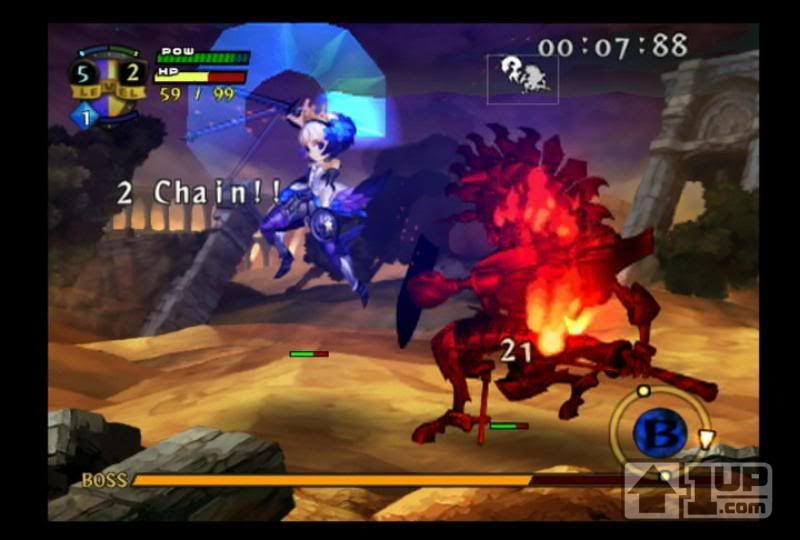
Gameplay wise areas are mapped on a number of circles (or "spheres" if you will, though not really- see the bottom right corner of the screenshot) traversed one a 2D plane. Each circle has one or more exit points from which you can get to one of the other areas that make up whichever country/area you're currently making your way through. Battles are fought in real time and make use of a limited combo system. Each one is ranked by how fast you complete it and how much damage you take (as well as a few other things that currently escape me). However, you can't go too crazy because a pow meter limits the number of swings you can take before becoming incapacitated for a few seconds and vulnerable to attack. Balancing this out are the innumerable other techniques you are constantly employing mid-fight.
"Spells," such as they are, are gained as you level up your weapon. This is done by killing enemies, which releases psyphers into the surrounding area. You then hold R1 to suck these in, leveling up your attack power and spell abilities, as well as filling up what is more or less your MP bar. Spells such as a cyclone that takes up a vertical line and progresses through a level can also damage you, while some spells have effects on the player, such as granting a 5X attack power for one blow, but draining HP to 1.
Much of the meat of the game comes from gardening, and not in a gay, Harvest Moon that's-neat-I'll-never-play-that-again kind of way. Planting seeds you pick up along the way produces little sprouts that also feed on the same phozons you use to level up your weapon and charge MP. Each plant has a different number of phozons needed to grow, with varying results. One, the rosmile, needs none and produces 15 phozons to help whichever nearby plant you want to give a leg up. Another, the napple, requires 18 phozons and produces two peach-fruit thingies that give you some HP and give your HP experience. Yep, you level up your HP with experience gained by eating. My personal favourite plant thus far is the sheep tree, which sprouts two live sheep at full growth. Killing the sheep results in tasty, tasty lamb chops, which give 200 hp and 150 exp, as well as having two portions each. There's also a kitchen you can go to, and for a little cash you can have them cook up a tasty, experience rich meal from whatever ingredients you've got on hand.
Alchemy! There have been a squillion FMA games and Odin Sphere does alchemy better than all of them. Starting with base materials (well, really just one called a "material" kept in a vial) you combine these materials with various types of (deceptively cute) mandragoras to make various helpful potions. For instance, combining a Material (0) with a Habanerista mandragora produces "Cooler" tonic, which helps prevent damage from intense heat in volcanic areas. Other mixes include napalm and toxins to use on your enemies. Mandragoras themselves are found by listening for squeaks as you walk through stages. Jumping on said squeaky areas produces a cute little animated root that runs about till you kill it mercilessly.
Finally there's the story. I know I made fun of the claim of the game's back cover that you should "lose yourself" in an "intricately spun tale worthy of a place in the canon of classic literature," but it's really a fantastically told story. It starts out sounding early on as if it's going to be a cookie cutter affair with stereotypical players, but character development starts quickly and you quickly become interested in why each character is doing something, and when you do find out it actually fits instead of turning out they were trying to revive their dead science experiment mother-thing from a lab or something.
The downside of the game's segmented nature are load times. While not always long, there are plenty of them. Additionally once in a while you'll come across an oddly animated character that seems a little off at first, but you generally get used to it quickly. There will sometimes be a bit (read: lots) of slowdown when a bajillion sprites show up on the screen. Thankfully this doesn't happen too often, but when it does it's jarring. Finally, the item system takes some getting used to. You're not meant to horde items but use them copiously, and if you try to keep them as you would in a normal game you'll get frustrated very quickly.
If I've made it sound complicated that's because it is, but the game itself does a very effective job of introducing the basics to you and letting you go from there. The visual and visceral come together to make it a really special game. The PS2 has had a couple of so-called "swan songs" before now, but I wouldn't be disappointed if this was really it. Buy it before you can't find it. Odin Sphere is worth every penny.